Showing posts with label Reference. Show all posts

Tuesday, 13 March 2012

Marvel 1602


While I'm busy not writing the session report post, here's a very short mini-review of a comic. The LFG/used book store has closed down, and in that process they sold out everything in the store for a buck a piece. I came late to the party, but I still managed to snatch a few treasures. Among them the eight periodicals that make up the first part of Neil Gaiman's take on a 17th century Marvel Universe well into alien space bat territory.

Monday, 5 March 2012

Historical References: Dominion of Langrim

This is a return to an old category. This time I'll look at a few aspects of the fantasy setting of Langrim, a pseudo-medieval affair with monsters, wizards and paladins. As usual, these images are drawn from our own history, and the intention is to provide a common frame of reference between myself and the players.


These jolly fellows are Byzantine cataphracts from around the 11th century. This is how the Legion appears, although they've swapped the scimitars for longswords.


Here we have a breakdown of the equipment of a Norman Knight. This is how most of the Knights of Greenvale roll. There will be some amongst them who wear plate, perhaps even full plate, but by and large most warriors on the island wear chain.


The bastle was a common sight on the Anglo-Scottish border in the 16th and 17th centuries. In this age of frequent skirmishes and prolonged unrest, these fortified farmhouses offered some protection from reivers and raids across the border. In the Dominion the threat comes from goblins and other evil creatures of the dark.


Lastly there's the motte-and-bailey castle. The Normans really dug these, and while they have several drawbacks compared to the stone fortifications that became all the rage in later centuries, they should work well against an enemy who rarely stays in the field once the sun rises. They also have the added advantage of being comparatively cheap to raise, and though labour intensive, cheap to maintain.


[Picture source: 1, 3 & 4 regretfully unknown; 2 - WrathDT]

Wednesday, 15 February 2012

How archery should be done


So, say a combat round lasts 10 seconds. I counted seven arrows, and judging by the footage at the end, her grouping is flawless.

Sunday, 5 February 2012

Featured Artist: Matthias Grünewald

It's been a while since the last one of these, and this time I have something truly twisted for you. Matthias Grünewald (1470- 1526) is a bit special, in that he bridges the Renaissance realism that was all the rage back then, and the balls-to-the-wall, scaring-the-shit-out-of-you-to-make-you-pray mentality of the Medieval painters[1].


As has become the form of these posts, I'll skip any further pontification on the topic and show you some of the artist's work. Note that all of these images are sections of altar-pieces, not named or linked to due to good old laziness.


Wednesday, 17 August 2011

Historical References: Shield-wall


From antiquity to modern days, the shield-wall has allowed a small number of trained fighters to control or defeat a horde of rabble. The concept is quite simple: The men stand in formation, shoulder to shoulder so that their shields overlap. This way an enemy is denied the ability to flank the fighters one by one. Throughout history this tactic has been used by amongst others the Persians, Spartans, Romans, Vikings, Saxons, Normans, and in our own age, riot police.


Sunday, 17 July 2011

Historical References: The Lost Expedition

Relics from the lost expedition, published in the
Illustrated London  News, 1854

Do not go gentle into that good night
Rage, rage against the dying of the light.

~Dylan Thomas
It is 19 May 1845, and the two ships HMS Terror and HMS Erebus are setting out on an expedition to find the near-mythical North-West Passage. Aboard are 129 men. The vessels are outfitted with the most sophisticated and modern inventions — no expenses have been spared. Both have modern steam-engines and screw propellers, making them capable of travelling at a speed of 4 knots under their own power. They have reinforced hulls, and steam-powered heating for the crew-quarters. They have supplies to sustain the members of the expedition for five years. The commander of the mission is Sir John Franklin.


Saturday, 16 July 2011

Non-magical loot: Singing Bird Pistols


These should be worth a hefty sum in just about any setting, and probably well worth a little crime. This particular pair was sold for $5.8 million in May this year, after "[...] an epic bidding war between two of the world’s most connoisseur collectors who fought fiercely for more than 10 minutes." [source]  Now if that isn't enough to make you hum the theme from Mission Impossible, you're in the wrong hobby.


Thanks to Kevin Mowrer for the video.

Monday, 4 July 2011

From my shelves: Leviathan


One of the things that naturally follows...er...precedes moving is packing. While boxing my RPG-books yesterday, I had to stop more than once to leaf through a tome I'd half forgotten. I'll readily admit there are books I probably wouldn't ever remember, should I decide to part with them, but there are also some treasures amongst them. One of these is Grendel's Leviathan. This "post-apocalyptic fantasy battle system" was published in -95, and I assume it never made it big.


I picked it up in a discount-bin sometime shortly after Y2K, not because I wanted a mini-game, but because of the artwork by Adrian Smith. Once I'd read through the fluff-section, I came to like the setting as well. The five factions of the game are dwarves, elves, goblins, humans and orcs. While this is far from innovative in and of it self, these five pieces should illustrate some of what's made me remember Leviathan. The goblins have become my standard go-to-goblins for my fantasy games, and the elves became the First Fallen of Argos. As for the steampunk dwarves, they're just too cool for school.


I did some light looking, and Leviathan-minis are still available, for those of you who have such inclinations.


EDIT: Yup, there's also a blog dedicated to this game. I love the internets.


Thursday, 30 June 2011

Evolution: Appendix N


Continuing on the Evolution-project, this time I'll try to compile a list of reference literature. These books all have elements of what I see fitting in the new age of Argos. Again, this is mostly for my own benefit, as a way of gathering my thoughts, but I can recommend each of the titles listed below.

Sunday, 29 May 2011

The Second Coming


Turning and turning in the widening gyre
The falcon cannot hear the falconer;
Things fall apart; the centre cannot hold;
Mere anarchy is loosed upon the world,
The blood-dimmed tide is loosed, and everywhere
The ceremony of innocence is drowned;
The best lack all conviction, while the worst
Are full of passionate intensity.

Surely some revelation is at hand;
Surely the Second Coming is at hand.
The Second Coming! Hardly are those words out
When a vast image out of Spiritus Mundi
Troubles my sight: a waste of desert sand;
A shape with lion body and the head of a man,
A gaze blank and pitiless as the sun,
Is moving its slow thighs, while all about it
Wind shadows of the indignant desert birds.

The darkness drops again but now I know
That twenty centuries of stony sleep
Were vexed to nightmare by a rocking cradle,
And what rough beast, its hour come round at last,
Slouches towards Bethlehem to be born?

W. B. Yeats


Tuesday, 24 May 2011

Reference: Treasure Planet

Events have conspired to delay the chapter-post a little, so instead I'll post this one from my archives. Its also quite relevant, as there's been some failed attempts at placing the reference to the Orcus Galactica mentioned in the previous chapter.

Treasure Planet is by far my favourite Disney movie, and it scores high on my list of animated movies as well. Instead of delving into a synopsis of the plot-line, I'll just say that, yes, it is an adaption of R. L. Stevenson's Treasure Island. It follows the original fairly closely, except for a few minor changes. The main difference being the setting. Instead of taking place in our world in the mid-18th century, TP is set in an alternative universe. Space-galleons with solar sails have replaced the sailing-vessels of the original, and Long John is cast as a right charming cyborg. In addition, there are aliens, uncharted planets, laser-cannons, and space-ports. Also, Jim Hawkins is portrayed as a somewhat moody surfer kid with authority-issues, but given the general coolness of the rest of the movie, I managed not to let that spoil my mood (he's still more sympathetic than Anakin in E. II & E. III).

One thing I'd like to mention, while we're on the topic. Lately I've read Flint and Silver and Pieces of Eight, both by John Drake. These are the first two books in Drake's prequel-trilogy to Stevenson's classic. The third book, Skull and Bones is next on my reading-list. If you liked the original, or if you just have a soft spot for pirates, I can recommend these whole-heartedly.

Now, since this is a reference-post, here are the pictures.


RLS Legacy leaving the Montressor space-port

Space-galleon under sail

View of Montressor


Montressor's docks

The RLS Legacy under sail

RLS Legacy escorted by schools of Orcus Galactica


[The rights of all images belong to the Walt Disney Corporation]

Wednesday, 5 January 2011

Historical Reference: Sports I


Those who know me know that I do not give a rodent's tail about sports in general. However, I recognise the fact that sports are a vital part of any culture. A made up culture should not be different, and therefore I have been giving this some thought. I could pinch Blood Bowl from Warhammer, or pyramid from BSG, but I'd rather not. There are countless other fictional sports out there as well, some more plausible than others.

Then it struck me. There has to be some real-world sports that would fit into the world of Argos. Some digging around the internets proved me right. I love it when that happens.


Calcio Storico is a Florentine sport from the late 16th century. The first rules were published in 1580 CE, and it is still played today. Each side has 27 players, you can use both hands and feet, and apart from kicking someone from behind, everything goes. The goal is to get a ball into a net on your opponent's side of the field, and a game lasts for 50 minutes, no breaks. That's more or less it. At least that's how I'm interpreting it.

The following links are to pages providing background and information on Calcio Storico:
Wikipedia
Holiday Apartment Tuscany

Unfortunately, the English language YouTube video I found has embedding disabled, so you'll have to be satisfied with a good old [LINK]. Watch it. Seriously. If you are at all interested in the topic, it is well worth the five and a half minutes.

For the Wikipedia-entry on fictional sports, you can follow this link.


How does this fit into the world of Argos? 
The history of the Calcio goes back to the days of the Old Empire, and is still played in most Erian realms. At times it has been tried banned, but never successfully. Most cities and many towns have a league, with games played during the summer. Neighbouring cities also often meet for bi- or triannual matches. Regardless of whether it is a local or a neighbourly game, honour and glory will always be at stake.


[Picture source: 1 Turismo2.it; 2 Brainz; 3 The Telegraph]

Sunday, 17 October 2010

Historical References: 17th Century Space Programme


A little while ago, Akrasia over at Akratic Wizardry, posted on the 17th century Jacobean Space Programme. I'd never heard about it at the time, and it literally made me sit up straight and take notice. Since then I've done some light digging, and, damn! those guys were serious about it. And so, since this topic dovetails ever so neatly with the world of Argos, I'll devote an HR-post to this matter.


“[There] may be some other meanes invented for a conveyance to the Moone, and though it may seeme a terrible and impossible thing ever to passe through the vaste spaces of the aire, yet no question there would bee some men who durst venture [this].”
-Dr John Wilkins, The Discovery of a World in the Moone (1638)


The Reverend Dr John Wilkins (1614 – 1672), brother in law of the right famous Oliver Cromwell, studied at Oxford in the early 1600's, and later became a strong advocate of an expedition to the moon. The precepts of this, in hindsight utterly outrageous proposition, were as follows:

  • European science was on a roll. Great and wondrous discoveries were made in the fields of geography, astronomy and anatomy. 
  • Men like Kepler and Galileo were making great discoveries about the structure of the world, e.g. the planets orbited the sun.
  • It was an age of great explorations. Magellan, Drake and Columbus were setting out on grand voyages, and returning with new and previously unimaginable knowledge of our of planet.
  • These new discoveries were not made through studies. No ancient texts told of the location of the West Indies, for instance. These new insights were the fruits of the work bold men of the Enlightened Age. It was an age of empirical science - I can prove it, therefore I'm right.
  • The old belief in the truths of the ancients - Aristotle, Ptolemy, Hippocrates, and so on - were exchanged for modern scientific facts all across the board.

The issue of the fallibility of the ancients is a factor Dr Allan Chapman places great weight on in his lecture. In prior generations, learned men were scholars (i.e. reading the works of the great minds of the old world), whereas now they were scientists. Chapman almost goes as far as to say that a great motivator for these modern minds were to debunk the myths of the Greeks and the Romans. Jupiter, for one, was thought to be another star on the night sky. Through examination through modern means, however, it was proven to be a planet with its own moons orbiting it.

The moon, again according to the ancients, were thought to be a silvery ball. Through the telescope, however, it looked as if it had landscapes akin to what we find here on earth. It actually appeared like there were areas fit for habitation, and if God in His wisdom created a habitable place, would He then not create inhabitants to dwell there as well?

So how did the Reverend Dr Wilkins propose to get there? Being a man of reason, he had devised an elaborate plan. According to his calculations (bear in mind that this was before Newton got the apple in his his head), reaching a hight of about 20 miles would allow one to escape the earth's magnetism, and thus fly through space. He further reasoned that once the expedition slipped free of this pull, the digestive systems of the crew would no longer be subject to the confines of terrestrial mechanisms. In fact, they would no longer feel hunger, and so would not need to bring any food. A great weight saver right there.

On the issue of breathing, Dr Wilkins argued that once the astral explorers became accustomed to breathing the pure air the angels breathed, they would not suffocate, or even become light-headed - something experienced by mountaineers.

As for the means for transportation, the good doctor had it all worked out. Ten or perhaps twenty men would form a club, each paying 20 guineas or so to have a blacksmith assemble the ship from a set of elaborate plans. Using great springs, clockwork mechanisms, feathers from high-flying birds, and gunpowder, the ship would then, from a low angle take-off, become airborne. And once in the air, all you had to do was set a course for the moon.

However, by the 1660's, after a series of experiments with flying machines, Dr Wilkins had come to axcept that the moon was yet out of his reach.

In the original post, Akrasia mentioned the new RPG Clockwork & Chivalry, and wondered whether this would be incorporated in this game. In the comments, Ken Walton, of Cakebread & Walton: Purveyors of Fine Imaginings, the team behind C&C, could confirm this. Here's a snippet from his reply: "It’s the talk of the town in the London coffee houses – how everyone’s buying shares in the Company of Gentleman Adventurers Trading into the Moon! In the London docks a ship is being built, designed by Clockwork genius John Wilkins, a ship that can fly."

That game is on my Christmas List.

Sources:


[Picture source: Verybadfrog.com]

Tuesday, 21 September 2010

Historical References: Cartography

Word: Cartography
From: Greek chartis = map, and graphein = write
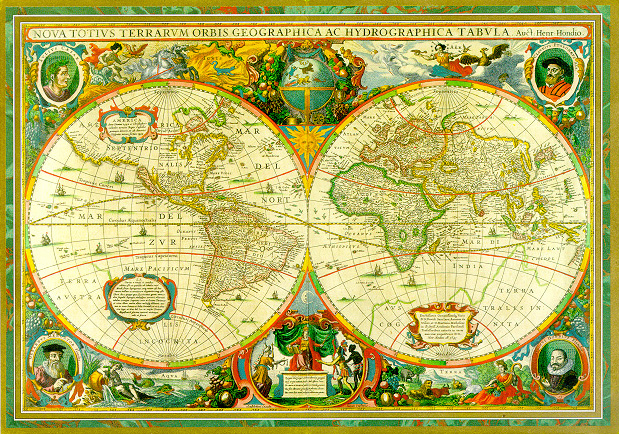
From Mercator and Hondius'  Novus Atlas, mid-17th century

[The 17th century is] described as the Golden Age of map-making.
-Diedrick Wildeman

One of the lads, the Captain's player, just came back from travelling, and he brought back KLM's in-flight magazine, the Holland Herald (HH). The relevance here is an article about cartography in the 17th century, with a (hardly surprising) focus on the illustrious Dutch map-making tradition.

The reason for the player's, and also my own, interest in the topic is of course that the Netherlands of the 1600's is the chief source of reference-material for the Wezellian Syndicate of the Book of Worlds. That and our common love of maps. And so it is that this HR comes to deal with that very topic. I'll draw upon Andy Round's Secrets of the map-makers article in HH's September 2010 edition, as well as the omni-potent and all-knowing internets to shed some light on this topic. And of course I'll ground this in the world of Argos.


In the 17th century, the world was still a confoundingly large and mysterious place. White areas on the maps abounded, and even for known regions the maps didn't necessarily match the terrain. Still, the available maps were all anyone had. The era was also a time of increased exploration and trade -- the two being closely related.
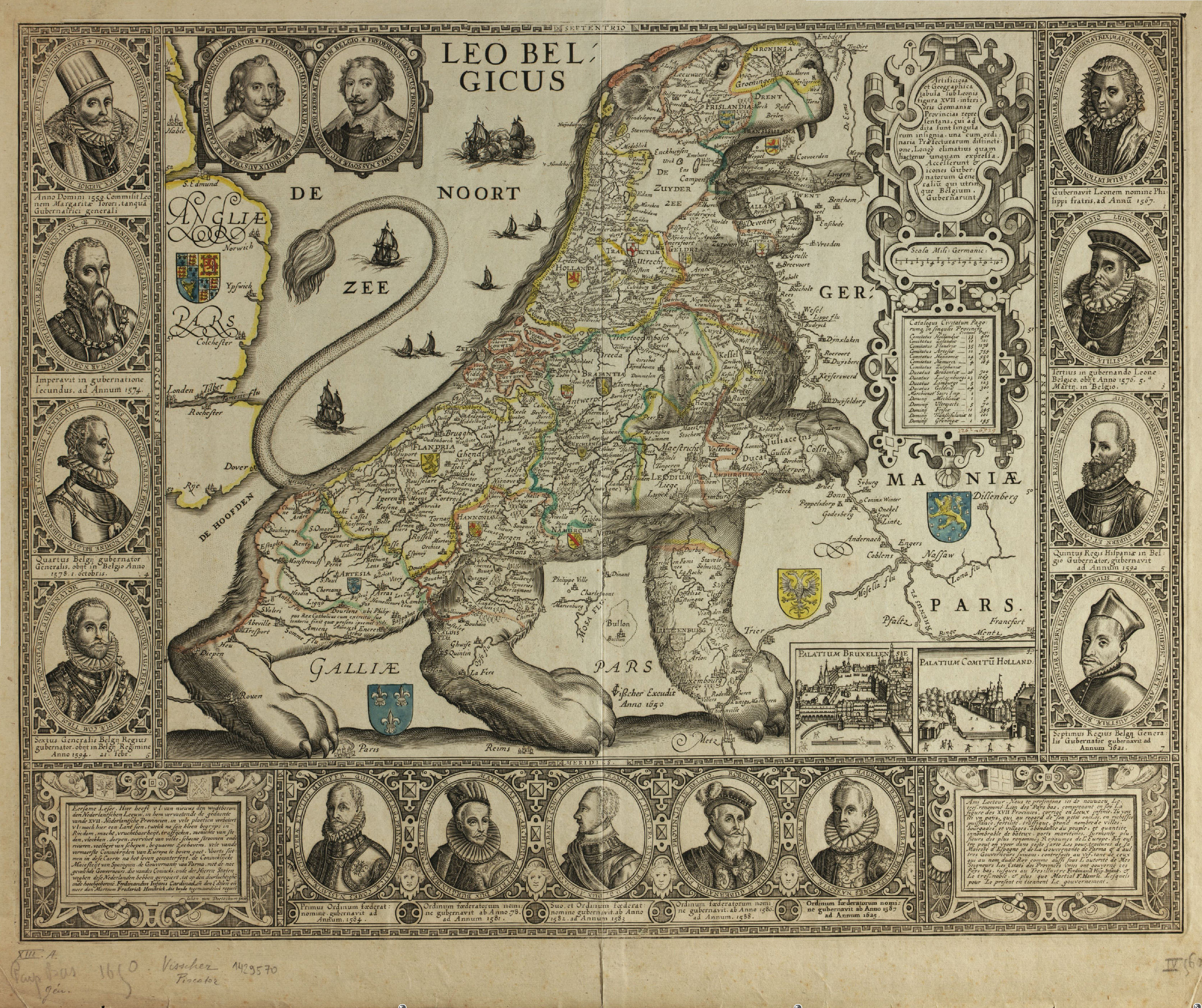
Leo Belgicus, a popular rendering of the Netherlands.
The Lion was drawn facing different directions, according
to where the most prominent enemy lay.

The HH article discusses the two major seafaring nations' different approaches on the availability of maps, or if you will, information. The Dutch Golden Age is usually said to span the century, and coincides with the rise of mercantilism. The beginning of the century also saw the formation of the Dutch East India Company (VOC), the first multi-national company ever, and also the first to issue stock. As a point of interest, it can also be called the world's first true megacorportion (Cyberpunk 2020 anyone?), but that's neither here or there. The VOC was most important in fuelling the Dutch economy, and for about 200 years it dominated European trade with the Orient.

Spanish Armada leaving off the Galician coast, 1588

Spain, on the other hand, was at this time a proper empire, ruled by the crown and a powerful nobility. Its overseas acquisitions were initially quite a disappointment, but in the 1520's that changed. Vast deposits of silver were found in Mexico. Eventually this led to the downfall, and bankruptcy of the Spanish Crown, as the almost exclusive import of precious metals caused a massive inflation, as well as the increased dominance of a feudal aristocracy. "The silver and gold whose circulation helped facilitate the economic and social revolutions in the Low Countries, France and England and other parts of Europe helped stifle them in Spain," Wikipedia.

To conclude this part of the history-lesson, other nations were of course involved, but they didn't get in the game properly yet, arguably due to all manner of domestic or neighbourly squabbles.

The North Sea, 1573

Now back to maps. In Spain, the maps of the colonies, and thus the world, were hand-drawn affairs, and kept under lock and key by the Crown. Smuggling maps out of the realm was considered an act of espionage, and was carried a death-sentence. Round gives a brilliant example of the value of this approach, in 1628 the Dutch captured one of the legendary Spanish Silver Trains, the crown was left on the verge of bankruptcy for a year.

The Dutch on the other hand had a different approach. Having access to the best engravers and printing presses of their age, and also a most efficient trade network, they opted for the sharing of information as the best way of expanding on their knowledge. Still expensive (an atlas could cost about as much as a present day second home, according to Round), it was still well within reach for an aspiring merchant house. Another factor is that the leading cartographers of the time happened to be Dutch.

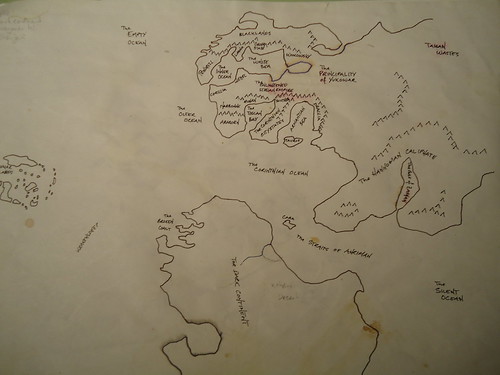
Western Argos
Eria and surrounding regions

Cartography on Argos.
While there are many superficial similarities between 17th century Europe and Eria at the end of the Third Age, there are a some major differences. Chief of the latter is that while Europe had in earnest started to reach out into the world for resources, Eria has not fully come to need external resources yet. At the dawn of the Third Age, a population greatly diminished by generations of war, both with each other and with the elves, now held a continent rich on natural resources.

For most of that age, no realm or nation needed much more than could be found on the Erian continent. Once the need outgrew the local supplies, the vast Northern Regions, or the ancient colonies on the Dark Continent, were sufficient to meet the needs of the growing realms of man. Combined with trade with the rich Waymar Islands in the West, and with the vast Caliphate in the East, the need for global exploration never truly arose.

Another factor in this is that the Royal Guild of Argonauts held a de facto monopoly on true navigation on the high seas. Limited charts, routes, or even guiding of convoys across the Outer Ocean were provided by the guild. Additionally, even in this Dark Age of Magic, certain pseudo-arcane techniques and rudimentary goetic instruments were available to navigators. This reliability on the supernatural, and of course the dangers of crossing the dark depths of the oceans, meant that naval exploration were regarded as closely affiliated with the dark arts, and thus regarded as dangerous at best, and a sure path to corruption at worst. Most Erian nations still regard the high-risk, high-profit naval trade as a most ignoble business.


[Picture source: 1 Tower of Babel; 2 & 3 Wikimedia Commons; 4 Carta Marina; 5 Atlas, vol I]

Wednesday, 7 July 2010

Historical References: Wings of Death

Did I mention I love history?

I do. I love history because it is full of people, events and phenomenons that surpasses everything fiction has to offer. Therefore I draw a lot, if not most, of my inspiration from the annals of our own past. As an example of this, I will devote this post to what may very well have been the most awesome attempt at attaining the Shock-and-Awe effect so many commanders have strived to accomplish.

Ladies and gentlemen, I give you...

The Winged Hussars of Poland

Imagine hundreds of steel-clad horsemen thundering towards you. Man and beast bound together in rage and hatered, all bent on destruction. You feel the very earth you stand on shake, and the din of hooves and steel makes it impossible for you to hear anything but your own cries. What could possibly be more terrifying?

What if they looked like the proverbial angels of death?


In the 16th and 17th century Europe, people were, as a rule, superstitious. Plagues, defeats in war, the still birth of a child, even physical disfugurations, were all blamed on the Will of God. And this is what the Poles took advantage of when they attached wings to the backs of their cavalry. The 'Golden Age' of the husaria began with the Battle of Lubiszew in 1577, and lasted til the Battle of Vienna in 1683. During these hundred years, the Winged Hussars fought countless actions against just about every army in Europe, and rarely lost a battle.

And they still look awesome.


In the world of Argos, the Ruhanian Hussars, devout Humanists and fiercely loyal to the Arch Primarch of the Temple of Man Supreme, use such wings, and inspire the same terror in the hearts of their enemies. The Angels of Death is one such unit. In 1020 YE it became famous for supressing the First Lazarian Uprising, crushing the peasant army, and massacring thousands in the aftermath.


[Picture source 1 dziarski @ VisualizeUs; 2 The Husaria]

Sunday, 27 June 2010

Armory

Here you'll find a collection of the arms and armour worn by the people of Argos, from the humble wooden club, via crossbows, to revolving rifles. The span in sophistication is due to the recent influx of technology caused by the Ordo Ultima Thule and the Commonwealth of Man in Argonian affairs.


Ranged
Flintlock Pistol


Damage 3
Range 15/30/60
Strength 2
Clip 1
Cost ••

Flintlock Blunderbuss

Damage 5
Range 10/20/40
Strength 3
Clip 1
Cost ••

Flintlock Musket
Damage 4
Range 35/70/140
Strength 3
Clip 1
Cost ••


Flintlock Rifle

Damage 5
Range 60/120/240
Strength 3
Clip 1
Cost •••


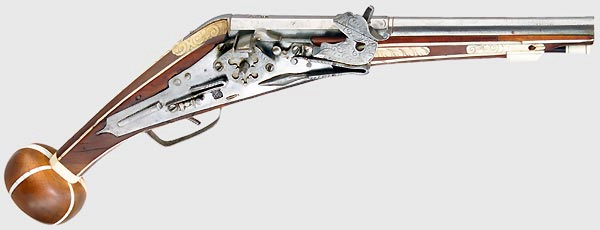
Wheellock Pistol
Damage 3
Range 10/20/40
Strength 2
Clip 1
Cost 


Wheellock Musket

Damage 4
Range 25/50/100
Strength 3
Clip 1
Cost ••


Wheellock Rifle

Damage 5
Range 50/100/200
Strength 3
Clip 1
Cost •••


Matchlock Musket


Damage 4
Range 20/40/80
Strength 3 (w/ support)
Clip 1
Cost 


Revolving Pistol
Damage 3 AP
Range 15/30/60
Strength 2
Clip 4 to 6
Cost •••

Revolving Rifle
Damage 5 AP
Range 60/120/240
Strength 3
Clip 4 to 6
Cost ••••

Doxworthy Navy No. 5 revolver
Commonwealth of Man

Damage 5 AP
Rate of Fire: 2
Range 30/60/120
Strength 2
Clip 6
Cost ••, Non CoM characters add •

Merrit-Cartwheel Mk XIV rifle
Commonwealth of Man

Damage 6 AP
Rate of Fire: 2
Range 80/160/320
Strength 3
Clip 5
Cost •, Non CoM characters add •

Crossbow
Damage 3
Range 40/80/160
Strength 3
Cost 


Hand Crossbow 

Damage 1
Range 10/20/40
Strength 1
Cost ••


Melee
Club (wood)

Damage 2 (B)
Size 2
Cost n/a


Mace
Damage 3
Size 2
Cost ••


Knife

Damage 1
Size 1
Cost 


Dagger

Damage 2
Size 1
Cost 


Main Gauche


Damage 1
Size 2
Cost 
Special: +1 to defence vs. melee attacks.


Rapier
Damage 3
Size 2
Cost ••


Broadsword

Damage 3
Size 2
Cost ••


Longsword

Damage 4
Size 2
Cost ••


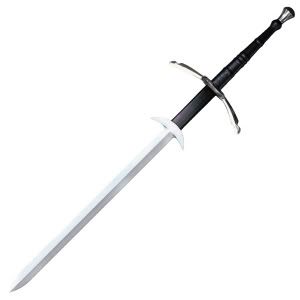
Greatsword
Damage 5
Size 3
Cost •••


Small Axe

Damage 2
Size 2
Cost 


Battleaxe
Damage 3
Size 2
Cost ••


Partisan
Damage 3
Size 4
Cost ••


Halberd
Damage 4
Size 4
Cost ••


Pike

Damage 3
Size 5
Cost 


Armour
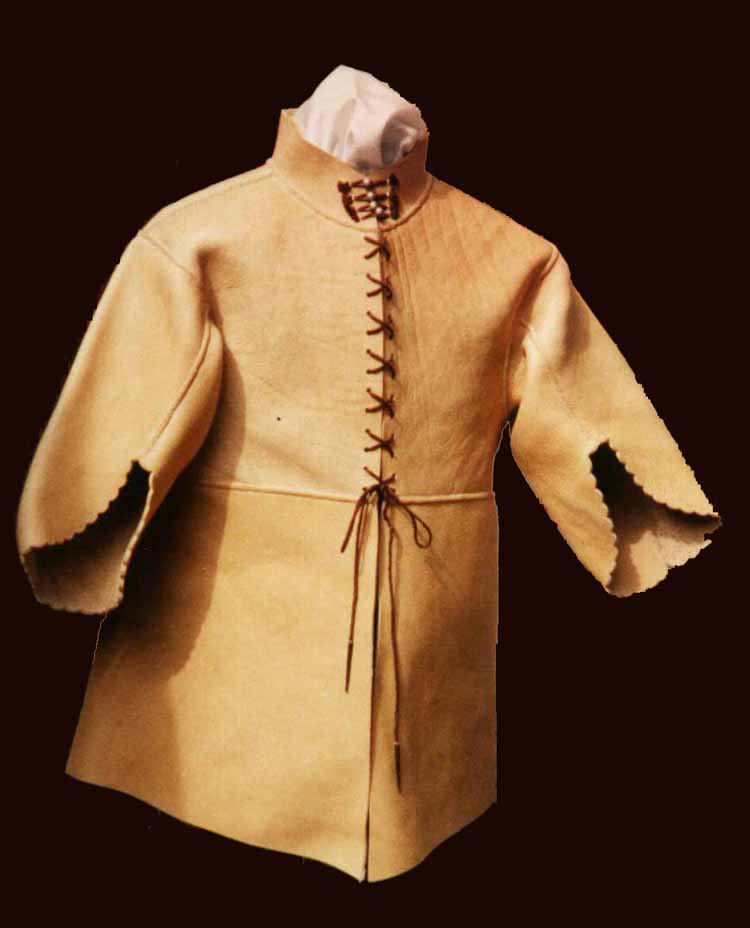
Buff Coat
Rating 1/0
Strength 2
Defense -1
Cost 


Breast Plate


Rating 2/1
Strength 3
Defense -1
Cost ••


Hussar Armour

Rating 3/2
Strength 3
Defense -2
Cost •••


Cuirassier Armour

Rating 4/3
Strength 3
Defense -2
Cost •••


Gothic Armour

Rating 5/3
Strength 3
Defense -2
Cost •••


Infantry Helmet (Morion)

Rating 1/0
Strength 2
Defense -1
Cost 

Cavalry Helmet (Lobstertail)

Rating 1/0
Strength 2
Defense -1
Cost 


More arms and equipment here.