Showing posts with label Argos. Show all posts

Sunday, 26 June 2011

Evolution: The Malleable Paradigm


Yesterday I began the Evolution-project, and today I'll have a look at one of the fundamental concepts of Argos. I'm talking about how reality is defined, or, what governs the fundamental laws of reality. I'm not sure this will make a lot of sense to everyone, but the way I see it, this is perhaps the single most defining phenomenon in this world.

Saturday, 25 June 2011

The Evolution of a World


Lately I've been talking a bit about endings, but after every end there is a beginning. Even if the Pius Chronicles are drawing to a close, Argos will live on. The world has been a big part of my life for some years now, and I do not feel like we will be parting ways just yet. Great and terrible things have happened to it since I first visited it. Though nearly, but not quite cataclysmic, these events have greatly changed the world. Some of these events have been played out, others must be allowed to run their course. This post is the first in what will likely be a new series, where I pour out some of my thoughts on how the world will look once the dust has settled. If I'm lucky, this will take Argos into the Fourth Age.

Saturday, 8 January 2011

Fragments of Truth and Fiction I


"In dark chambers beneath the streets they meet every night. During the days they walk among the populace, masking their marks of devotion. They know the truths the others strive hard to ignore, they are the harbingers of the final awakening. Theirs are the secrets of the Drowned Man."


"None are as feared on the battlefields of the Enlightenment War as the Livonian cuirassiers; their very appearance on the field can be enough to break the will of the mislead and the corrupted. They are truly invincible, for in their hearts burns the True Light of Creation!"


"Deep in the bogs he found what he had sought for so long, but in finding it, he also sealed his fate. The price demanded was such as would damn the one who paid to torment and despair, and the treacherous path he was on led only further into the mire."


"I have been walking for so long. That is my destiny. To walk forever. There are so many things to witness, so many roads to walk. Staff in hand, I press on on paths both deep and aloft. Ever since that fateful day when the seal was broken, ever since that fateful day I have been walking. My only hope is that I wont be too late."


Wednesday, 20 October 2010

An Introduction to the Book of Worlds


This is something I've been meaning to write for a long time. If you are a new player in the Book of Worlds, or if you are just plain curious, this is the first post you should read. It should give you a basic understanding of the world of Argos, and the events that are taking place there.

This post will be edited to reflect changes in the world, and links will be added to this text as the relevant posts are published.

For any questions you may have, please post them in the comment field - I am notified of comments even on old posts - or you could talk to me in person, if that is an option. I will do my best to provide a satisfying answer.

Introduction
The world of Argos is dominated by Early Enlightenment-era cultures, and much of the real-world reference material used to build it is drawn from the 17th century. This is the age of flintlock pistols, of fencing and intrigue, of burgeoning science, of pikes, muskets and cavalry, of trade and piracy, and much more. Think Three Musketeers, Solomon Kane, the English Civil War, the Thirty Years War, Francis Bacon, Isaac Newton and Galileo Galilei.

It is also a world in which magic is awakening after having been suppressed for a millennium. The history of Argos is the history of the rise and fall of civilizations, of mythic ages and great wars between good and evil, between races, kingdoms and religions, and even between gods and men.

Unlike our own world in the corresponding period, this world has not yet reached a stage where the world is mapped out, let alone fully settled. There are vast tracts of land where no civilized being has ever walked, and in these regions, fantastic and terrible things dwell. The world is divided into different Realms, or Paradigms, and each such Realm has its distinct metaphysical rules. Why this is so, or the exact nature of these differences is one of the great mysteries.

At present, the Third Age is coming to an end, and the Great War has broken out all across Argos. The Old Enemy, the Sleeper in the Deep has gathered its strength and is now reaching out to devour all of Creation. The world is changing, and the chronicles of the Book of Worlds are about that change.

Eria
Many peoples call Argos their home, but current events focus around the Erian continent. Here we find the kingdoms that formed the Hegemony of Man after the last Great War. Most of these realms sprung out of the old Skythian Empire - the Empire that defeated the gods and the elves in a long series of wars known as the Godslayer Wars and the Wars of Domination. Having driven all supernatural influences out of the World of Man, the Empire then outlawed magic, a decree that stood for a thousand years.

Throughout the Third Age, the Erians have stood divided between the two rivalling belief systems of the Cabal of Pure Thought and the Temple of Man Supreme. Both believed that humans were the highest form of life in all Creation, and that any other race was a blasphemy. 


The Cabal held hard work and rational thought to be the ideals all should strive towards, and against which all were measured. In the last years, the Cabal has been splintered, and most of the Northern Realms are now part of the Enlightened Alliance. This new alliance is united against the common enemy, the Sleeper in the Deep. It also recognises the importance of magic in this fight, and has removed many of the old laws against the supernatural.

The Temple on the other hand, worships the pure soul of man. It has become infiltrated and controlled by dark conspiracies secretly aiding the Enemy. In Southern Eria, religious fervour and old superstitions are being whipped into a frenzy of fear and hatred, most of this directed against the Enlightened Alliance and the witches and demons who control it. This hatred is also directed at any one suspected of witchcraft or free thinking; the smoke of the pyres have long been a common sight over the cities, towns and villages of the South.

Another factor in this age is the return of the gods. Most of the gods of man were slain, and their worshippers were killed or driven into exile as the Second Age drew to a close. Now a few of the old gods are returning, and new ones are appearing as man tuns to the supernal for aid and consolation. Temples and shrines are appearing all over Northern Eria, while the Black Hand persecutes any such worship with ruthless vigour in the South.

The World of Argos
Argos is more than Eria. To the north we find the Wild, a great land-mass covered in impenetrable wilderness, steep mountains, endless plains, and deep, dark forests. Only the northern shores of the White Ocean and the western coast of the Wild has been settled. These are both shielded from the Wild by ragged mountain ranges, and few humans have braved the lands behind. Rumours and legends tell of ruins of lost civilizations, and of foul creatures inhabiting this large white area on the map.

To the east we find the enormous Principality of Wukowsky. This feudal realm stretches from the eastern shores of the White Ocean and into the icy Lands of Endless Winter. While the Erian kingdoms have reached a state of enlightened development, the Principality is stranded in a dark-age agricultural society. The nobility lives in unfathomable opulence - the serfs live a life of endless toil and hardship.

Further south we come to the Hannuman Caliphate, a large realm consisting of deserts, jungles and archipelagos. It is ruled by the Council of Awakened Viziers, a conglomerate of religious magicians following the teachings of Aziz. One of the first major battles of the Great War was fought on the sands of the Caliphate, and it was in this battle that Aziz gave his life so that the fallen Daeva, Grishnak, could be defeated by the first of the younger gods,  the Lord of Nightmares. 

The death of the Daeva released a flood of magical energy that caused a mass of awakenings all over Argos, nowhere more so than in the Caliphate. The war on Grishnak also left countless nightmares free to roam the lands, and today the Caliphate is still struggling to rebuild.

Before we leave these lands, two distinct realms should be mentioned. One is the Hermetic Order State, located on the northern shores of the White ocean. The other is Draccia, home of the Wolf Lords. These mythocracies survived the the wars on the supernaturals that cleansed the World of Man of their kind, and has become a part of the world as the Erians sees it.

The Hermetic State is ruled by the Ordo Hermetica, probably the oldest magical order in the world. Few outside the Order has been past the port city of Goeteshafen, but rumours tell of weird and wondrous things being commonplace between the mountains that shield the lush farmlands of the realm.

Draccia, on the other hand, is a feudal state where the Wolf Lords make up the ruling class. These shape-shifters seldom venture outside their borders, but lately they have become involved in the Great War, as have the Hermetics.

South of Eria, on the other side of the treacherous waters of the Straits of Ahriman, lies the Dark Continent. Legend has it that it was here that Man first arose from the dust of Creation, and that it was here that the Sleeper in the Deep fell onto Argos. It was also here that the First great War was fought. Since then, the continent has been all but abandoned by the civilized tribes, and up until recently the only known settlements were in the Old Colonies on the north of the continent.

A generation ago, the Orc tribes of the Dark Continent became united under a great warlord named Ghurandahk. In but a few years he had acquired industry, and forged his race into a vast army. This army he first turned on the Old Colonies, and before any force could be brought to bear, he had conquered all of the human realms on the continent.

An army was assembled to reclaim the lost colonies and defeat the Dark Horde. This army, the Host of Man, was the first human force in more than a thousand years to be supported by magic. Still, after months of fighting gruesome battles against this terrible enemy, the campaign had to be abandoned.  Now the Dark Continent is outside the World of Man.

In the far east lies the Kithayan Empire, called the Empire in the Middle of Time by themselves. Few Erians have ever been this far east, and even fewer have been allowed to travel these mysterious lands. The Kithayans themselves seldom travel the world outside their borders, and what exchange there is between Eria and this realm is through trade conducted mostly by Hannuman merchants.

The last place we'll visit on this tour is the Waymar Islands, far to the west of Eria. It was here that the Covenant between humans and elves was signed at the end of the Second Age. These rich islands have drawn adventurers and dissidents from the Erian realms ever since, and many an adventuring gentleman has struck rich on trade or other, less honest endeavours on the Islands.

Finally, beyond the Empty Sea, somewhere over the horizon, legends say that there is a vast and beautiful land, the land of the elves. Some claim to have been there, but none have been able to recall the course they sailed, or what star they followed to reach those distant shores. Many more are those who have set out to find the elven harbours, only to never be heard from again.

The Book of Worlds
The world of Argos is a part of a greater multiverse. This multiverse encompasses all of Creation, and all the metaphysical planes. The Prime Material plane, or the physical reality, is where we find Argos. Other worlds and other planes have an interest in the events taking place here, and sometimes agents from these places will meddle or interfere with what's going on here.  Still, while these outside forces may try to affect the world of Argos, they are not the focus of the story.


The most active of these outsiders are the Ordo Ultima Thule. This organization comes from a dead world far away, and their goal is to awaken the Sleeper in the Deep. They are far more advanced than the cultures of Argos, and they employ dark arts and foul rituals to warp the human body and soul to serve their blasphemous goals.

The Game
The Book of Worlds is about mystery, magic, horror, and the eternal struggle against good and evil. It is about the fallibility, and the folly, of man. It is about telling a captivating story, and seeing the characters and the setting change and grow as a result of the choices made.


The game is Mage: the Awakening, with elements of the other White Wolf-lines thrown in. There is also an element of fantasy added to the mix, as well as a liberal dash of Call of Cthulhu - the Sleeper in the Deep is in fact the Great Old One.

Further reading
The following posts also provide valuable information on the setting.
Argos, a short introduction - the first introduction post, written when the world was still relatively young.

Atlas, vol. I - a Flikr album that contains most of the maps I have drawn for Argos. A work in progress.
Chapters - here you can find play-reports of the previous sessions.
Historical References - this is the label I use when I publish source material from our own history.
Languages - A list of the languages spoken on Argos.
Mechanics - under this label you will find some of the house-rules of the BoW, as well as a few resources for playing and understanding the system.
Metaphysical Topography - here you can read about the various planes, and how they relate to the physical reality.
The Pantheon of Argos - an overview of contemporary deities.
Timeline - this timeline is kept up to date, and most important events are listed.
Tower of Heavens - the Rosetta Stone of the Book of Worlds. This is the first written material ever produced for this setting, and almost everything since is based upon this.

Under the "Index" header in the side-bar of this blog you will find a list of links to informative posts and resources of my own making. Further down, under "Other Resources," you can find relevant off-site resources that will help you build and play a character in the Book of Worlds.


[Artist: Keith Thompson]

Tuesday, 21 September 2010

Historical References: Cartography

Word: Cartography
From: Greek chartis = map, and graphein = write

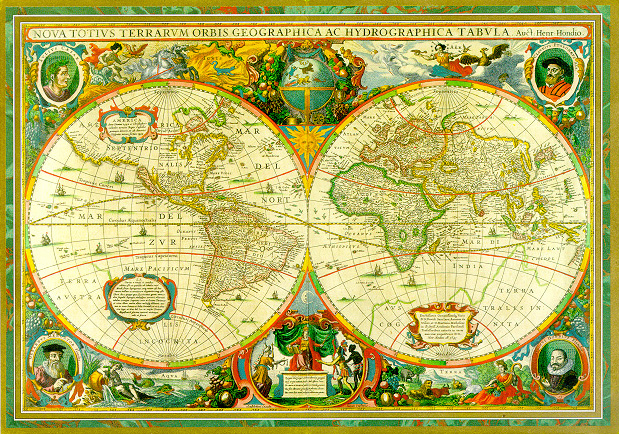
From Mercator and Hondius'  Novus Atlas, mid-17th century

[The 17th century is] described as the Golden Age of map-making.
-Diedrick Wildeman

One of the lads, the Captain's player, just came back from travelling, and he brought back KLM's in-flight magazine, the Holland Herald (HH). The relevance here is an article about cartography in the 17th century, with a (hardly surprising) focus on the illustrious Dutch map-making tradition.

The reason for the player's, and also my own, interest in the topic is of course that the Netherlands of the 1600's is the chief source of reference-material for the Wezellian Syndicate of the Book of Worlds. That and our common love of maps. And so it is that this HR comes to deal with that very topic. I'll draw upon Andy Round's Secrets of the map-makers article in HH's September 2010 edition, as well as the omni-potent and all-knowing internets to shed some light on this topic. And of course I'll ground this in the world of Argos.


In the 17th century, the world was still a confoundingly large and mysterious place. White areas on the maps abounded, and even for known regions the maps didn't necessarily match the terrain. Still, the available maps were all anyone had. The era was also a time of increased exploration and trade -- the two being closely related.

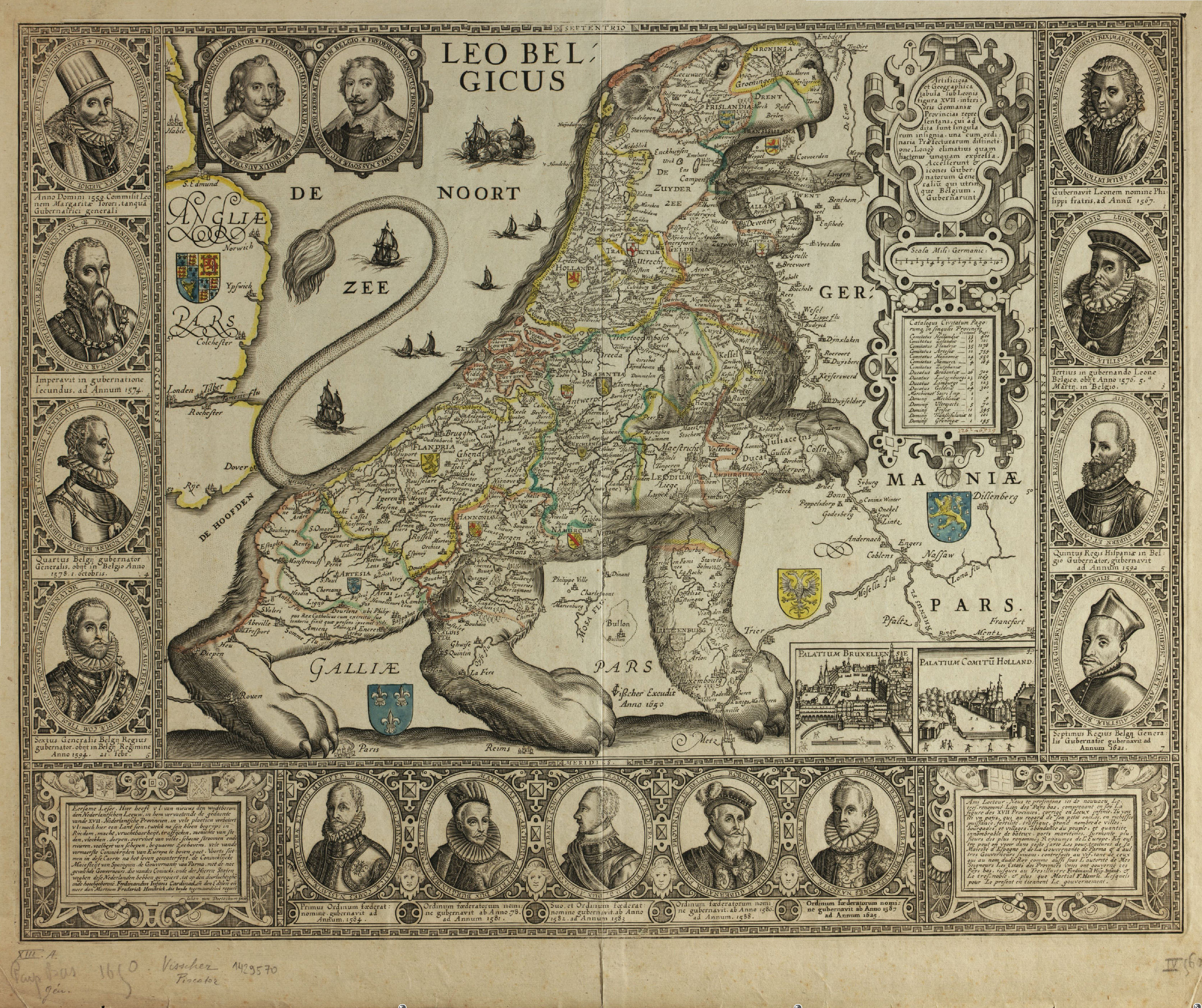
Leo Belgicus, a popular rendering of the Netherlands.
The Lion was drawn facing different directions, according
to where the most prominent enemy lay.

The HH article discusses the two major seafaring nations' different approaches on the availability of maps, or if you will, information. The Dutch Golden Age is usually said to span the century, and coincides with the rise of mercantilism. The beginning of the century also saw the formation of the Dutch East India Company (VOC), the first multi-national company ever, and also the first to issue stock. As a point of interest, it can also be called the world's first true megacorportion (Cyberpunk 2020 anyone?), but that's neither here or there. The VOC was most important in fuelling the Dutch economy, and for about 200 years it dominated European trade with the Orient.

Spanish Armada leaving off the Galician coast, 1588

Spain, on the other hand, was at this time a proper empire, ruled by the crown and a powerful nobility. Its overseas acquisitions were initially quite a disappointment, but in the 1520's that changed. Vast deposits of silver were found in Mexico. Eventually this led to the downfall, and bankruptcy of the Spanish Crown, as the almost exclusive import of precious metals caused a massive inflation, as well as the increased dominance of a feudal aristocracy. "The silver and gold whose circulation helped facilitate the economic and social revolutions in the Low Countries, France and England and other parts of Europe helped stifle them in Spain," Wikipedia.

To conclude this part of the history-lesson, other nations were of course involved, but they didn't get in the game properly yet, arguably due to all manner of domestic or neighbourly squabbles.

The North Sea, 1573

Now back to maps. In Spain, the maps of the colonies, and thus the world, were hand-drawn affairs, and kept under lock and key by the Crown. Smuggling maps out of the realm was considered an act of espionage, and was carried a death-sentence. Round gives a brilliant example of the value of this approach, in 1628 the Dutch captured one of the legendary Spanish Silver Trains, the crown was left on the verge of bankruptcy for a year.

The Dutch on the other hand had a different approach. Having access to the best engravers and printing presses of their age, and also a most efficient trade network, they opted for the sharing of information as the best way of expanding on their knowledge. Still expensive (an atlas could cost about as much as a present day second home, according to Round), it was still well within reach for an aspiring merchant house. Another factor is that the leading cartographers of the time happened to be Dutch.

Western Argos
Eria and surrounding regions

Cartography on Argos.
While there are many superficial similarities between 17th century Europe and Eria at the end of the Third Age, there are a some major differences. Chief of the latter is that while Europe had in earnest started to reach out into the world for resources, Eria has not fully come to need external resources yet. At the dawn of the Third Age, a population greatly diminished by generations of war, both with each other and with the elves, now held a continent rich on natural resources.

For most of that age, no realm or nation needed much more than could be found on the Erian continent. Once the need outgrew the local supplies, the vast Northern Regions, or the ancient colonies on the Dark Continent, were sufficient to meet the needs of the growing realms of man. Combined with trade with the rich Waymar Islands in the West, and with the vast Caliphate in the East, the need for global exploration never truly arose.

Another factor in this is that the Royal Guild of Argonauts held a de facto monopoly on true navigation on the high seas. Limited charts, routes, or even guiding of convoys across the Outer Ocean were provided by the guild. Additionally, even in this Dark Age of Magic, certain pseudo-arcane techniques and rudimentary goetic instruments were available to navigators. This reliability on the supernatural, and of course the dangers of crossing the dark depths of the oceans, meant that naval exploration were regarded as closely affiliated with the dark arts, and thus regarded as dangerous at best, and a sure path to corruption at worst. Most Erian nations still regard the high-risk, high-profit naval trade as a most ignoble business.


[Picture source: 1 Tower of Babel; 2 & 3 Wikimedia Commons; 4 Carta Marina; 5 Atlas, vol I]

Tuesday, 6 July 2010

Metaphysical Topography


The fabric of the multiverse is made up of five different planes, the Prime Material, the three ethereal planes, the Astral, the Shadow and the Underworld, and the Abyss.  Each of these abide by its own laws, and denizens of one may not act without impunity in another, even if they may at places overlap. The barrier between the Prime Material and the Umbral planes is called the Gauntlet.

The entities that dwell in the ethereal planes are often referred to collectively as spirits, although anyone who have studied the matter will agree that this is a far too generic term. Still, most of the ethereal beings share a common trait -- they lack a permanent physical manifestation, something that hampers their abilities to interact with the Prime Material.

Ancient myth tells us that before the Fall all the planes existed in harmony; spirits, humans, ghosts of the dead, gods, avatars and elves, all existing side by side. If the oldest sources are to be believed, each knew their place in the metaphysical framework of Creation. While this didn't mean that all were equal, interactions between the realms were guided by the Compact.

The details of this Compact has been lost in the mists of time, and some claim that the existence of such a thing is nothing by retrospective romanticism. Still, the Batini believe that the Bans, Boons and Contracts that govern many ethereal denizens' interaction with the Prime Material Plane stems from this ancient Compact.

The topography of the ethereal planes are not easily quantifiable in terms understandable by man. Concepts like space, time and matter all adhere to different rules than in the Prime Material. There are also different realms within the planes, some being in a state of constant flux, others utterly unchangeable.

Most knowledge of the realms beyond the Gauntlet has been lost, or destroyed in the Great Purge following the Covenant, and much has never been known by anyone born by woman. There are also things so unfathomable that the knowledge of which will break the mind of those who learn it.

The Prime Material Plane
The physical world, or worlds, if you believe the words of certain Outsiders, are found on this plane of existence. The Prime Material plane is the home of all things living, and all things physical. It is the plane on which the world of Argos nestles, and the natural home of man, beasts, mountains and forests. The Wise argue that the Prime Material binds the three ethereal realms to existence, and that should the one cease to exist, the three would unravel. They say that this is where the Circle of Creation continuously unfolds, death following birth, and destruction following creation, over and over again; without this, the rest would be nothing.

The soul of man is bound to the Prime Material Plane at birth, and passes beyond at death. This, the Temple of Man Supreme argues, proves the blessed nature of man, for no other entity is part of all Creation in such a manner, and man is alone amongst all created in having both an eternal soul and a corruptible flesh.


The Ethereal Planes
The Shadowrealms
When someone passes through the Gauntlet from the Prime Material, they enter the Shadow. Everything native to the Shadowrealm is composed of ephemeral spirit, and here all spirits are alive. Of all the ethereal planes, this is the one that is closest to the to physical reality.

Closest to the Gauntlet the metaphysical landscape will resemble that on the other side, but places with a strong resonance will appear more physical, while those without might be missing all together.

As one travels deeper into the Shadowrealm, the surroundings will become more primordial, and man-made structures will become few and far between.

It is said that there are caves or dark passages in the Shadowrealms that leads down to the Underworld, or even to the Abyss.

The Underworld
Death comes to all who live, so goes the saying. This plane is anathema to life, and the living is not welcome here. The landscape may be made up of cavernous grottos, labyrinthine tunnels, or vast empty plains. What is constant is the feeling of absence. Absence of self, of hope, of colour. Absence.

Deep within the Underworld runs the River Styx, and many dead are put to their final rest with two coins to pay the Ferryman for passage to the Shores of Dìs. Now that the god of death has been slain, most of the dead never reach the Farthest Shore, instead becoming Lost, or worse, they are drawn into the cold river and swept out to the Deep.

Beneath the Underworld lies the Abyss, and now many of the foul beings from that blasphemous plane creep into the Land of the Dead.

The Astral Plane
This is the demesne of abstract concepts, of gods, and of beings so different from us that we cannot begin to understand them. Legends tell of great magicians who set out to explore these realms, only to become lost to the world for all time.

Amongst other things, this is where the gods make their home. Examples of divine realms are Ethelingagard and the Dreaming. Other such realms have drifted too deep in the Umbra to be reached, or abandoned to entropy and roaming spirits when the man killed his gods in the Second Age.

There are two major theories regarding the nature of the Astral Realms. The Humanists claim that it exists within the soul of man, that it is in fact the consciousness of the Enlightened mind. This theory states that by going deep enough, one may get to the very core of one's being, and thus to the core of Creation itself. The Hermetics hold this to be untrue, and instead see the Astral Realm as the sum of the consciousness of all of Creation.

The Abyss
With the Fall of the Exarch, the Tapestry was torn, and the balance was forever upset. The Speakers of MĂżn believe that before the Fall, there was no Abyss. They claim that the Things That Must Not Be comes from outside of Creation, and that such was the havoc wrought by their coming that everything was forever thrown into madness and chaos.

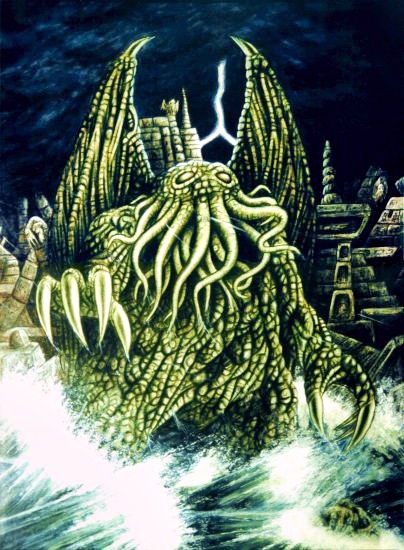
From the Abyss, dark things crawl forth, and foul things seep into the fabric of everything that comes into contact with it. Deep in its darkest depths the Lord of the Locust, Great Cthulhu, lies stirring, dreaming vile things into Creation.

Of all the Umbral Planes, the Abyss is the easiest to access from the Prime Material.

The Abyss and Paradox
There are ancient scrolls that speak of the Dawn of Man, when Hermes stole the fire of the gods. In these early days all things were in Harmony, and Paradox did not exist. Then came the Fall, and the Fabric of Creation was forever corrupted. Regardless of the truth in this, the insanity that often claim those magicians who disregard the dangers of vulgar magic lends weight to the argument.

Wednesday, 21 April 2010

Languages of Argos


Low Speech
Erian (Common Tongue)
The language spoken by Erians from Livonia in the north, to Tauros in the south. It is a mix of several old languages, and each nation has its own, very distinct dialect. A Pendrellian captain may haggle over the price of wine with an Alemani merchant, but both will find it difficult to keep a conversation about something outside their common business flowing. Erian is essentially a pidgin tongue, and as such no established linguistic rules exist. 


Skythic
Diplomats, nobles and scholars look at the Erian language with disdain. It has been said that you speak Common to your dog, but with your peers you converse in Skythic. The language hails back to the old Skythian Empire, and most works of litterature are written in Skythic.


Erian characters: 1 dot in Academics includes literacy and knowledge of Skythic.


Inbaric
The many tribes of the Hannuman Caliphate are united by the common language of the ancient Inbari. It is spoken in desert tents, in the caravanserais, and in the magnificent cities of the Caliphate.


Rukuwarian
The peoples of the Eastern Principalities trace their origin back to the Rukuwar tribe that settled the lands east of the White Ocean in the second century of Enlightenment. While Erian is spoken by merchants in the White Ocean ports, commoners speak nothing but Rukuwarian, and nobles will often deny knowledge of any other language.

Grawbehn
The realm of the Wolf Lords, Draccia, has its own language, and few outside the port city of Grayhaven speak anything but their distinct, harsh language.

GĂĽthrakh
The foul tongue of the Orc.


High Speech
High Skythic
A complex language, almost unchanged since the days of the Erian Empire. It is the ceremonial language of the Temple of Man Supreme, and is concidered the youngest of the High Tongues. Most texts from the last centuries of the Second Age is penned in this language.


Aryadic
Predating High Skythic, this High Tongue is seldom used outside the Realm of the Hermetic Order. It is sometimes referred to as Wizard's Speech, or Arcane, and in the Pogroms of Southern Eria being able to read Aryadic is concidered heresy.


Abyssal
The origin of Deepspeak is unknown, but some scholars -- of the few who are aware of its existence -- believe that it was the language of an ancient civilization that once lay on the northern shores of the Dark Continent. The few written examples, mostly fragments of stone tablets, have all been found in forgotten ruins in the Colonies. What is known is that Abyssal has strong connections to the Abyss.


Learning Abyssal brings with it dangers to the soul, and each time a new dot is purchased, roll Humanity - current dots.

Endarin
The Elftongue is said to hold great power over all things in Creation.


Dead Languages
The tribes of the old Skythian Empire each had their own language, but today these are only spoken by people in secluded regions, or by nationalist orders and lodges tracing their roots to before the Covenant. These days, the written languages of old can be found on runestones and in a few ancient texts.

These languages include:
• Penderii
• Alemani
• Livonian
• Wezelli
• Narbonese
• Aragania
• RĂ´haran
• Materassi


[Picture source: Economic History Blog]

Friday, 9 April 2010

Atlas, vol. I

Yes, at last the maps have been made available. Hopefully I'll get around to drawing some new ones soon, but don't hold your breath ;)

Anyway, the Atlas, vol. I is out, and a link have been placed in the Library-section of the sidebar.

God helg.

Sunday, 13 September 2009

Timeline of Argos

As drawn by the good Doctor Hieronimus el Rei Misterio, professor emeritus of Universidad Santandres, medicus, alchemist, astrologer, scholar extraordinaire, magician and formerly physician to his Exalted & Most Enlightened Majesty, King Carlos Pedreo XI of Aragorn.

~o~

First Age (Dawn of Man)*
  • The Dark Star falls upon Argos - the coming of the Exarch
  • Darkness comes to the world
  • The Fall of House Hedhrindal (Elf), and the Rise of the Black Blood (ref.: the Lament of the Orc)
  • The First Great War, wherein follows the Awakening of Man, the Darkness is defeated, and the Black Wyrm (Nefrangap, Troy, Ahriman) is defeated and imprisoned by Arkon (St Marcus, Huntsman)


Second Age (Mythic Age)*
  • The First City of Man is built in the land of Enokia
  • The Orc is vanquished by the armies of Man
  • The Eriandu tribe settles in Eria after defeating the Orc Horde of Nifsunfall
  • The War of the Silver Lance is fought between the Eriandu and the House Valedil (Elf)
  • The Rise of the Cults - the tribes of Man falls to religious worship
  • The Wars of the Priests are fought amongst Man, the gods unleash the Great Mortality - several of the great tribes succumb, the Eriadu amongst them.
  • The city of the Erdangars fall, ending the centuries long Angarlaw imposed on the Old Kingdoms of the North (Bolgen)
App. 500 BC (Before the Covenant)


  • The Scythian Empire defeats the deity Xuul in the Godslayer War
  • The death of the goddess Ruinn by the hands of (Prince Aegir of) the EnæïdĂąn triggers the Second Great War(?); Elf strikes at Man - weakened by the anger of the gods; Man goes to war against Elf and gods
  • The Scythii unify the Western Tribes under the Imperial banner - the lands of Eria is cleansed of gods and Elf
The last century of the Second Age
  • The Second Age ends with the end of the Great War, and the Covenant of Waymar
Third Age (Age of Reason)


YE 2 - 5
Lord Solar Agenmar Macharius of the Penderii leaves the Imperium and the Temple of Man Supreme, founding the Cabal of Pure Thought and the Kingdom of Pendrell. He is followed by the Livonii and the Wezellians.


YE 33
The Ordo Hermetica leaves the Dominion of Reason.


YE 213
The Skythian Empire collapses after Aragon declares its independence. The last Emperor, Agustyn IV of the House Adiadin, is killed by Istvan Palladinus of House Elderell, First King of Aragorn, thus ending the Imperial Line.


YE 213 - 257
Wars of Succession. The Great Houses of the Skythian Empire battle for the Iron Throne, ripping the Imperium apart. There are twelve emperors during these years.


YE 251
Wildemar Erenson is crowned as King of the Narbonii.


YE 262
The Ruhan tribe leaves the Imperial Remnant


YE 272 - 307
The Corinthian peninsula is factionalized. Cities and noble houses form independent states.


YE 311
King Ragmar II Hakenmark of the Ruhani defeats Hodrinus the Black Duke in the battle of the Temple Gates. The Enlightened City is declared a sovereign realm.


YE 399
King Thedrich Blacksleeves of the Alemani tribe conquers the three tribes of the Merenmarch and declares himself Emperor of Man.


YE 409
Emperor Thedrich I crosses the Elfswall and sacks the Enlightened City, occupying northern Corinth.


YE 421
Thedrich is defeated in the Battle of Cortona by the combined army of the Corinthian city-states and the Kingdom of Ruhan. Shortly after, the Enlightened City is freed.


YE 477
The High Masons of the Alemanii join the Cabal of Pure Thought.


YE 555
The colony of Victoria is founded by Aragorn on the Northern Shores of the Dark Continent.


YE 632 - 639
The Surge. Black Blood warbands attack Livonia and northern Pendrell.


YE 743
The Dukes of the Kingdom of Alemani elect Helmand Alfgarde as the first Emperor of the Enlightened Scythian Empire.


YE 959
Dr. John Locker's Tropospheric Gondola completes the first scientific flight of man in Pendrell.


YE 971
Franko da Cola is born in the village of Scutino in the Principality of Andron.


YE 995
The Crypt is opened. Magic awakens.


YE 997
The St Revan's Day Plot. A scheme to kill King Arthor XIII of Pendrell is thwarted by the Second Witness (Sir William Blackstaff, the Blackstaff).


YE 998 - 1022
The Reign of Reason. The Ministerium assumes full control over the Cabal of Pure Thought, and a period of persecution towards freethinkers and Awakened follows. This is brought to an end with the Elven Scourge and the Pendrellian Civil War.


YE 1000
The Orc is given Industry by an Outsider known as the Futurist or the Rogue Navigator (the Emmisary?).


YE 1002
The Black Horde of the Orc, led by Urgal Kahn Ghurandakh, conquers the colony of Victoria. The Barrier is broken by Franko da Cola.


YE 1003
The Living Prophet of the Hannuman Caliphate is slain by the Grishnak Gahalar. Aziz becomes the new prophet.


YE 1005
The last city of Man on the Northern Shores fall to the Orc.


YE 1008
The first cult of Shaitani is tried by the Ordo Manus Nigrum in Lavarre in Aragorn.


YE 1009
Frank da Cola reveals himself as Shaitani to an Argonaut in Freeport. He speaks of the Olympos and the end of the world.


YE 1011
Franko da Cola strikes at the Ministerium and the High Temple of Man, killing scores in both attacks.


The Black Horde turns south, crossing the Charred Plains and attacking the Empire of Stygia.


YE 1012
Truth until Paradox, by Franko da Cola, is published in Andron. It is blacklisted by the Temple the same year, and shortly after placed under a print-ban by the Ministerium.


YE 1015 - 1017
The Corillian War. The King of Narbonne, 'Mad' Phillyp, backs the Free Macharites of Corillia against the Ministerium. Pendrell declares war, and defeats Narbonne in the Battle of Crezen.


YE 1016
Aziz turns away from the Grishnak Gahalar. The War of Fate begins.


The Lost Regiment vanishes.


The Process of Enlightenment is started by the Temple of Man Supreme. The Ordo Manus Nigrum is given 'supreme discretion in all matters heretical and all acts of enmity against Man.'


YE 1017
Emperor Constantinius Ada of the Enlightened Skythian Empire is named Protector of the Temple of Man by Arch Primarch Inocens XI.


YE 1019
Friedrich Roeder, formerly margrave von Roeder and commander of thevLost Regiment, (somehow) manages to convince the Kings of Eria to raise the Host of Man.


YE 1020
A horde of Nightmares is unleashed on the followers of Grishnak Gahalar. Some are granted access to the prime material plane of Argos.


The good ship Pius starts her journey.


YE 1021
Grishnak's Legions of Light is defeated by Aziz's Mujahed and an army of Nightmares under Morfeus himself in the Battle of the White Tower. Aziz is slain by Grishnak, who is in turn slain by Morfeus.


The Counsil of Awakened Viziers declare that Aziz is the True Caliph, and rules the Caliphate in his stead.


The Host of Man musters on the island of Cora and invades the occupied Colonies. The host is cut off from the Lands of Man when their bridgehead on Cora falls to the Black Ships.


The Wezellian Syndicate strikes the Lex Arcanum from the Laws of the Realm, in effect making magic legal.


YE 1022
Pendrell declare war on all witches and magicians, and invades Wezell on the first day of the year.


The Five Forts are burned by a Great Dragon. The Great Hunt of the Frost Elves descends on Pendrell, this is known as the Elven Scourge.


King Arthor XIII of Pendrell falls on his own sword. Duke Rowar Garwellyn of Ayre claims the Oaken Throne. Civil war breaks out.


The host of Man is brought from the Dark Continent by a miracle of Arkon.


King Rowar II of Pendrell is crowned (20 Primium) and crosses the River Ayre, defeating the Parliamentarian Force in the Battle of Sander Bridge.


The First Arcane Congress meets in the Wezellian town of Ghoerwald (1 Tertium). The Concord is signed (21 Sextum).


The Enlightened Alliance is formed by Wezell, Livonia, Maravia, Pendrell and the Ordo Hermetica.


The Temple of Man Supreme calls for a War of Enlightenment on the Arcane Congress and the Enlightened Alliance.


Alliance forces cross into the Enlightened Skythian Empire (13 Septium).


The First and Second Battle of Geminon Field (22 Septium). The Flood army under Samil Raga is defeated by a small force of Kengellians and Wezellians, led by the deity Geminon and the Pius Cabal.


The Great Explosion of Rederhafen.


* The exact dates of the events of the First and Second Age are uncertain, I have therefore elected not to list these.


---

Storyteller's note: This is perhaps the most comprehensive outline of the history of Argos as of yet. Any errors or mistakes belong to the good Doctor Misterio.